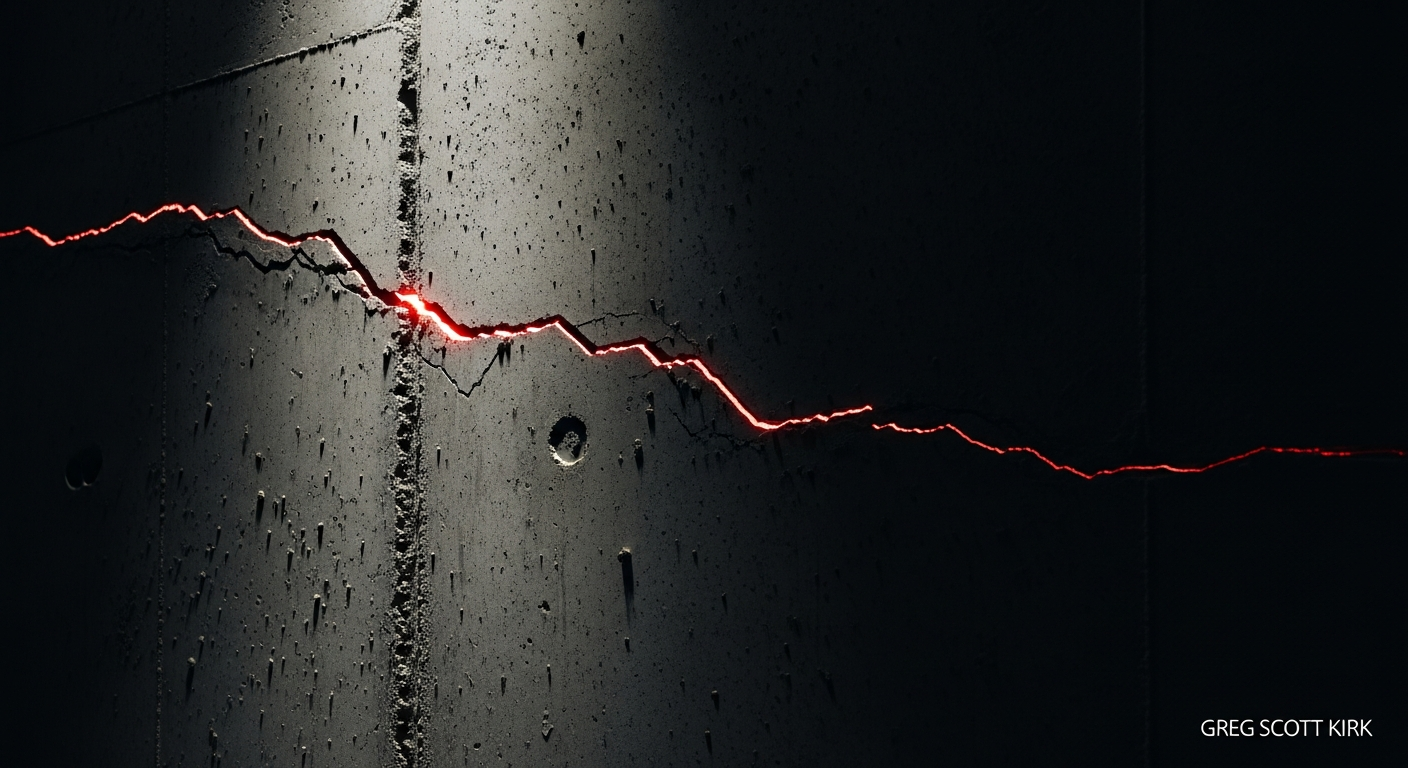
01. THE CRASH: TOTAL SYSTEM INTERRUPTION
In February 2026, the theory of resilience became a physical necessity. A motorcycle accident involving road debris on an Arizona highway didn't just shatter my wrist; it triggered a total system interruption.
When you hit the "Event Horizon"—that moment where the crisis is so loud you can no longer hear your own plans—your "Decoration" fails. The apps, the motivation, and the surface-level habits vanish. You are left with only two things: your physical hardware and your underlying code.
02. THE AUDIT: WHAT SURVIVES?
As I navigated police reports, insurance liability, and the reality of a reconstruction surgery, I performed a live audit of my business and my life.
- The Human Hardware: Compromised but stable. The Physical Discipline module from my Survival Kernel took over—rehab, movement, and nutrition became the primary inputs.
- The Digital Fortress: Fully operational. Because Paragon9 and P9 Source were built on an integrated Microsoft stack, the automation continued to execute. The "System" didn't care that the "Operator" was in a cast.
- The Mission: Unchanged. The directive to build a sovereign legacy remained the battery that powered the recovery.
03. THE LESSON: ENGINEERING THE COMEBACK
A crash is not a failure; it is a diagnostic. It shows you exactly where your infrastructure is weak and where it is bulletproof. My recovery is not just about bone and muscle—it is about refactoring the Operator’s Stack to be even more resilient for the next iteration.
We do not look for a backup of the old version. We build the version that can survive the next Event Horizon.
[SYSTEM NOTES]
- Incident Log: February 2026 Motorcycle Accident.
- Recovery Status: Reconstruction Protocol Active.
- Hardware Update: 1x Bionic-Style Brace (Winter Soldier Visual Protocol).
Stay Resilient.
— Greg Scott Kirk (Tek)
The philosophy is free. The engine that runs on it is Paragon9. If you're building something that needs to endure, book 30 minutes with me — no pitch deck, no sales pressure.